
A Primer on the Right of Military Members to Disobey Unlawful Orders

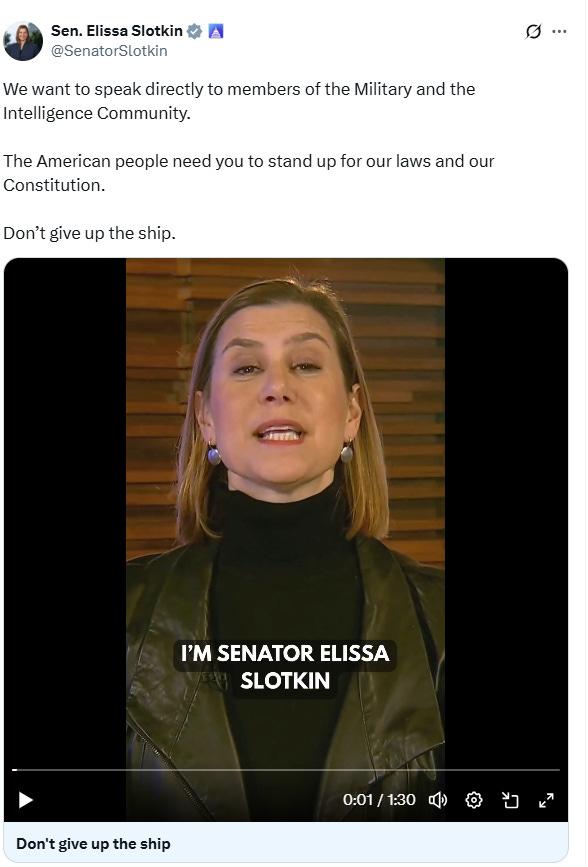
The principle that military members should only obey lawful orders is certainly getting a lot of attention today thanks to a video released today by six Members of Congress that served in the military or CIA. It reminds members of the military that they do not have to obey unlawful orders. Despite the fact that the video accurately stated the law, President Trump went ballistic, and in a series of posts expressed support for imprisoning and executing a group of Democratic lawmakers for what he termed “seditious behavior.” He posted that the video was “SEDITIOUS BEHAVIOR, punishable by DEATH!” and reposted another Truth Social post stating “HANG THEM GEORGE WASHINGTON WOULD !!”
Trump’s threats against the six Members of Congress are clearly over the top and highly improper, but I also thought that this episode was a good opportunity to explain what the Uniform Code of Military Justice (UCMJ) has to say about the issue. The bottom-line is that military member’s ability to disobey even orders that they think may be illegal is very, very limited.
Military members face a challenging set of rules. On one hand, Article 92 of the UCMJ makes refusal to obey any lawful order a criminal offense. On the other hand, compliance with an order that the military members knows is illegal could itself be a criminal act.
The U.S. military addresses this challenge by establishing a very strong presumption that orders are lawful. As you might expect, a military cannot operate effectively if every member of the military was empowered to question the legality of every order they receive. While legal training—especially on the international law of armed conflict—is an important part of military training, most military members are not in a position to judge the lawfulness of most orders. In most instances the recipient of the order will not have the information necessary to make any legal judgment. A soldier or airman may be told to target a particular building, but will have none of the information necessary to make any judgment about the legality of the target under international law.
Accordingly, the law sharply limits when military members can question the lawfulness of orders. While the UCMJ does not define what is meant by “lawful order”, the Rules for Courts Martial state that an order is lawful “unless it is contrary to the Constitution, the laws of the United States, or lawful superior orders or for some other reason is beyond the authority of the official issuing it.” The Rules further note that there is an “inference of lawfulness” of orders so any order “is disobeyed at the peril of the subordinate.” This inference of lawful has a very narrow exception: it “does not apply to a patently illegal order, such as one that directs the commission of a crime.” Some have called this a requirement to obey an order unless it is manifestly illegal—a high standard indeed.
This standard becomes even more challenging because the issue of whether the order is unlawful is an affirmative defense, to which the military member has the burden of proof.
As a practical matter, except for the most senior members of the military, this makes a refusal to obey an order a very risky move except in the most egregious circumstances—such as an order to kill civilians. More senior members of the military have greater access to the information needed to make these judgments—and access to senior military counsel as well. Even in these circumstances, if there is a Department of Justice or White House Counsel opinion that a course of action is lawful (as there reported is for the strikes on drug boats), a refusal to obey an order would still very risky indeed.
So what are we to make of all of this? Military members indeed have the duty to disobey unlawful orders, but the huge risks in doing so make it likely that only the most blatantly illegal order would ever be disobeyed.
A very useful and succinct summary of a very important and complicated doctrine. I would add three minor points: 1. The military takes this doctrine very seriously and maintains, or maintained a skilled and independent Judge Advocate Generals corps to ensure that soldiers, particularly those in the field have access to military counsel when confronted with such issues, so they didn't have to make such decisions on their own. Unfortunately, the Trump administration has purged many of the more senior JAG's. 2. I think the video by the Members of Congress was likely intended for the higher military command to reassure them that if an issue ever comes down to the invocation of this authority, Congress will have their backs. 3. You make a particularly compelling argument that determining whether an order is patently unlawful is likely to be extremely difficult. Then Trump goes out and calls for the execution of the Members of Congress who made the video. If he sends such instructions to the military THAT would clearly be a patently unlawful order.
Thanks Chuck. Very helpful analysis.