


I have written about two related problems. First, I have noted that our national debt is rapidly rising and will soon result rise to unsustainable levels. Second, I have noted that the Social Security and Medicare Trust Funds will run out of funds in the early 2030’s, resulting in an automatic 23% across the board cut in benefits unless Congress takes action. Indeed, the latest estimates by the Social Security Trustees is even worse: the trust fund reserves will be completely depleted in 2034 and the cut in benefits will be 27%.
How are the problems related? Social Security shortfalls currently account for about 20% of the federal deficit and Medicare shortfalls account for an even larger estimated 30% share. The shortfalls in both programs together therefore account for about half of the deficit.
I think we can be assured that Congress will “solve” the Social Security and Medicare shortfalls before 2034. Benefits will not be cut. Why? Because a beneficiaries are a huge voting block that will vote out of office anyone who failed to prevent the benefit cuts.
My concern, however, is that Congress will take the easy solution: change the law to decouple benefits from the trust fund and fund any shortfall with yet more debt. The result would be that Social Security and Medicare would be “saved”, but the unsustainable debt increases would continue.
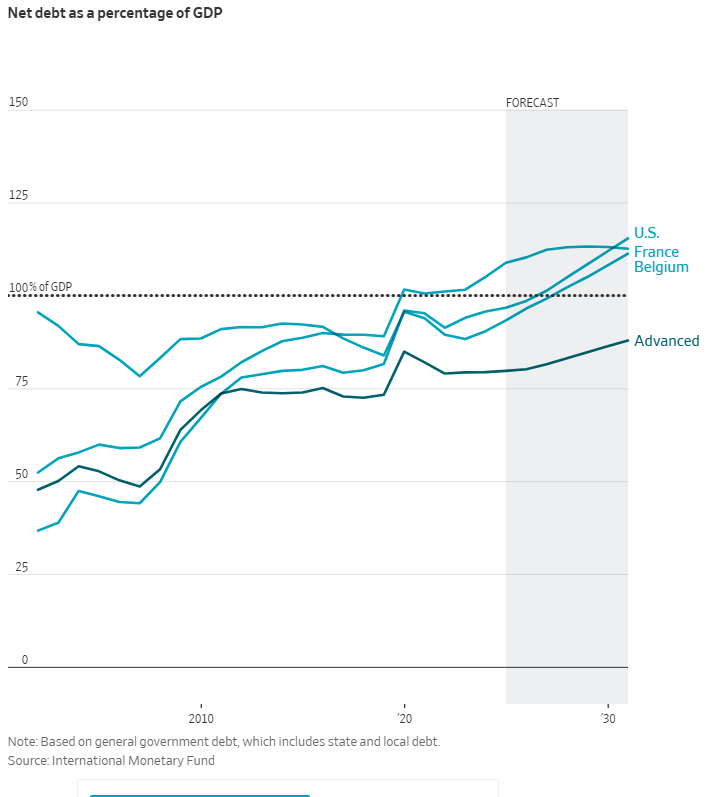
As explained in my previous post, debt that rises at the same pace (or better yet at a slower pace) than the growth in the economy may not be a problem. Debt that is growing faster that the economy as a whole, however, is indeed a problem. Sadly, net debt as a percentage of GDP is growing fast. Simply put, our debt is growing faster than our economy. The result has been rising interest rates (which hurts economic growth). Higher interest rates also affect our economy and the lives of average Americans in real ways. Housing becomes less affordable because of higher mortgage rates. Investment because more expensive so economic growth slows.
I think we need to take different approach: use the pending 2034 deadline as a way to improve Social Security and Medicare. While Social Security has greatly reduced senior citizen poverty, it generally does a poor job in helping those at the lowest income brackets. Standard benefits for low income Americans falls short of actual living costs, and a larger share of older adults have no personal savings or pension, requiring lower income Americans to work forever to make ends meet. On the other hand, for those of us in higher income brackets, Social Security is a nice supplement to already healthy pension and investment income. If we focus on enhancing benefits at the lower income brackets, while having the higher income bracket benefits a bit smaller, we can solve the shortfall while reducing senior poverty,
How could be do this?
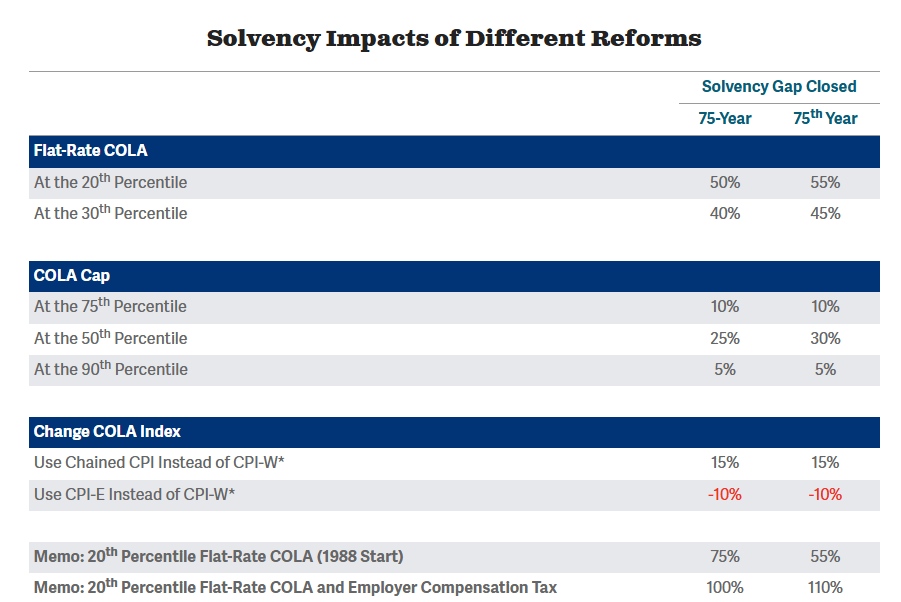
One proposal is for a “flat rate” cost-of-living adjustment (COLA). Right now all beneficiaries receive the same percentage increase in benefits to adjust for inflation. One proposal is to use a flat rate—the same amount of dollar increase for all participants. If the flat rate was set at the COLA for the 20th percentile of all beneficiaries, the result would be a larger increase in inflation for the lower fifth, about the same as inflation for most Americans and much less for the upper 20%. According to an analysis by the Urban Institute, this simple change would also greatly reduce the shortfall. If the fixed COLA is set at the 20th percentile, a flat rate COLA enacted in 2027 would cut the shortfall in half.
There have been other proposals for changes in the COLA structure, but most of these proposals hurt beneficiaries at the lowest income levels and actually do a worse job of addressing the trust fund shortfall. The fixed rate COLA on the other hand, protests the poorest fifth of participants, results in only a modest reduction for middle income beneficiaries, and put most of the cuts on upper income Americans.
Of course, any solution to the shortfall will require also require increased revenue as well. Options include raising the cap on income subject to social security tax to 90% of all wages from the current 83%, which would solve 25% of the shortfall. Other revenue options include a tax on investment income (not now subject to social security taxes), an increase in the social security tax rate (each 0.1 percentage point increase closes 3% of the gap).
Other benefit cut options include indexing the age for full benefits to longevity (solving 20%) or raising the age to 69 (39% of the gap or less if lower income levels are subject to lower retirement age. If you are concerned about the effect of these changes on low and moderate income Americans, there can be offsetting benefit changes. For example, you could set the minimum benefit at 125% of the poverty rate at a cost of adding 3% to the gap.
Given how close we are to the 2034 deadline, we may also may need a decade or or so of some general revenue funding—on a declining basis—to make the numbers work.
There are lots of options. There is a handy CFRB interactive tool you can use to explore many options.
We have two really tough problems—the Social Security Trust Fund shortfall and a national debt growing at accelerating rates faster then the economy as a whole. The solution to both problems will require creativity and tough choices. Any solution will require making tough compromises—a hard sell in today’s environment—but we have an opportunity here to remake Social Security into a more fair and viable program that protects the poor and moderate income seniors.
Hi, Chuck,
I just discovered your Substack. Hope all is well with you.
Best regards,
Ron
Ronald.Henry51@gmail.com