
Improvements in U.S. Life Expectancy: The Power of Incrementalism

Incrementalism has received bad press in recent years. Voters seem to distain small-bore policy ideas, and instead want their elected leaders to make bold change. During the Trump Administration, it is not enough to increase immigration enforcement. That type of incremental change is too tepid and boring for the Republican base. They want mass deportation of all those living in the US illegally NOW. During the Biden Administration, Democratic voters wanted more than stability and an end to chaos. Despite a narrow mandate, the Democratic base demanded a huge increase in social spending contained in the Green New Deal and the Build Back Better legislation.
Politicians who offer less ambitious policy ideas don’t do well in the primaries. Too dull. Too boring. Not at all inspiring.
This is unfortunate because incrementalism actually has a great track record in causing significant improvements in our lives. Bold ideas drive fundamental, radical change to reshape landscapes, while incrementalism offers steady, low-risk, step-by-step improvements. Incremental policy changes rarely get much attention because they are boring and not inspiring. Nonetheless they deliver.
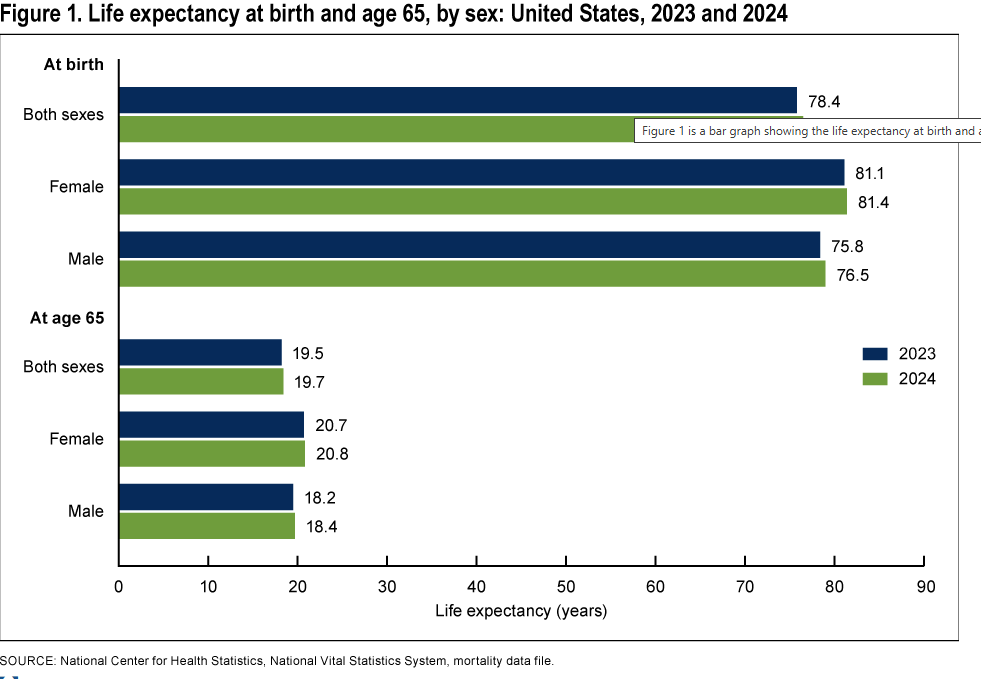
The announcement by the CDC yesterday that life expectancy is now at an all-time high is perhaps the best example of incrementalism in action. The announcement by the CDC was welcome news. After a drop in life expectancy at birth due to COVID-19 and an Opioid Drug Overdose crisis, we have made small—but steady—progress resulting in the highest life expectancy we have ever had. The average American born in 2024 is expected to live more than a full half-year longer than was the case in 2023. Life expectancy at birth is now at 79. There was also a small—but still significant increase in life expectancy at age 65.
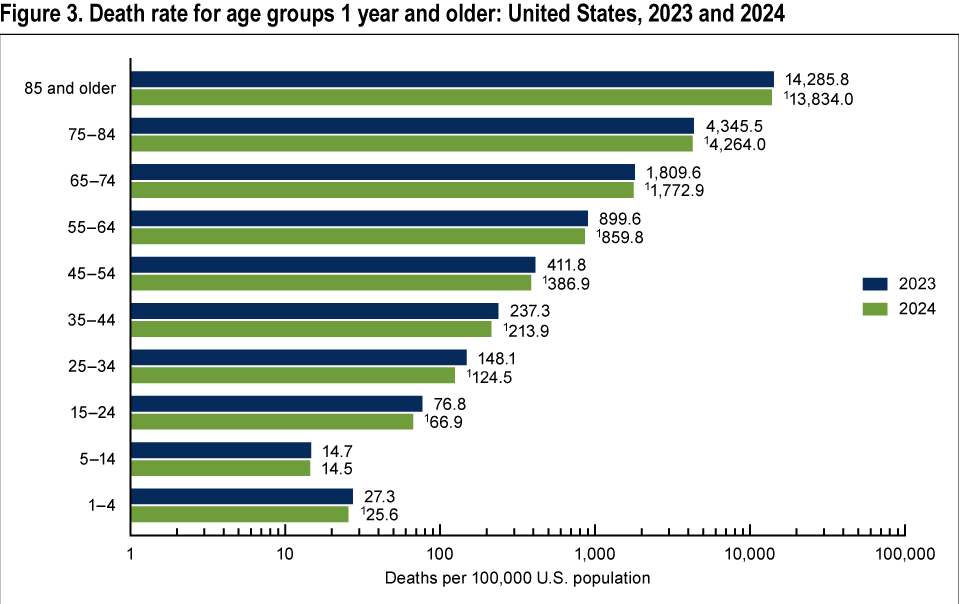
This good news was the result of a drop in the death rate for every age group.
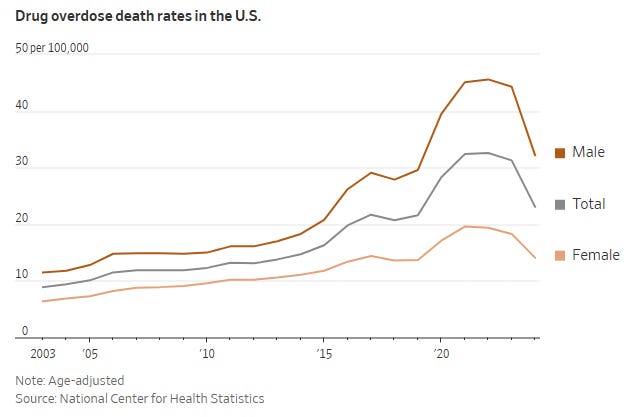
So what drove this improvement in life expectancy? One important factor that is receiving a great deal of attention is the recent drop in drug overdose deaths. As chart above shows, there has indeed been a big reduction in overdose deaths since 2020—due to several factors, including more cooperation by China in shutting down fentanyl precursor chemical exports and more universal access to opioid interventions such as NARCAN. Yet, while this is a great story, it does not come close to explaining the improvements in drug overdose deaths because drug overdoses are not one of the leading causes of death in the US.
So what explained the improvements since 2020? Was it a bold policy initiative by the federal government? Did the Biden “Moonshot” initiative against cancer explain these improvements? Did the ACA subsidy increase during the pandemic drive these improvements?
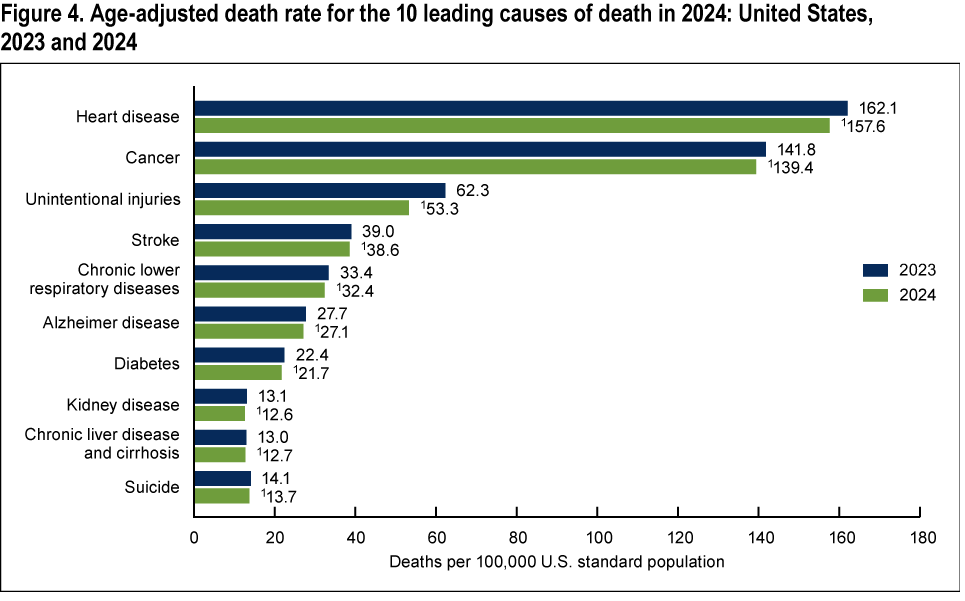
No—this was the result of incrementalism at work! The progress was the result of many very modest (indeed tiny) improvements in preventing and treating all of the leading causes of death. Even tiny changes can, over time, result in significant improvements. As the chart above show, the death rate for the leading causes of death all improved in 2023, and the end-result of these tiny improvements was a full 6 month improvement in life expectancy. It was hundreds of thousands of very small changes that drove longer life expectancy—new medicines, new tests, better guidance on prevention and wellness, improved suicide and violence prevention programs, small changes in product safety standards, and many other small changes.
Sadly, the Trump Administration’s “bold” efforts to defund universities and cut NIH spending may, over time, undercut future incremental improvements in life expectancy.
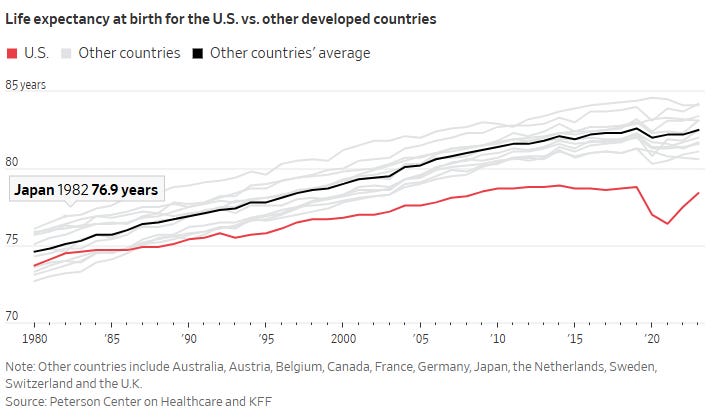
This is all good news, but US life expectancy rates still remain far below our peers in other developed countries. And until recently, the gap has been increasing. Americans die earlier and are sicker than those living in other developed countries. We obviously need to continue working the problem, but the lesson of our progress so far is that progress results from thousands of incremental improvements and not “bold” initiatives.
Aside from the fact that incrementalism works, it has several advantages over “bold policy initiatives.” First, bold policy initiatives often have significant implementation challenges. The initial rollout of the Obamacare health exchanges was a disaster. The Biden program to fund new EV charging stations made little progress before Biden left office. Trump’s “mass deportation” program is actually deporting far fewer people than was the case under the Obama Administration. All of these failures were the result of the difficulty in implementing major change. Incremental changes—because they are small and usually build on existing programs and infrastructure—are far less likely to have implementation issues.
Second, while “bold policy initiatives” are usually top-down initiatives that reflect one point-of-view about how to address a problem, incrementalism is a bottom-up “let all flowers bloom” approach. Medical progress is not the result of a single-minded focus on a small number of scientific ideas, but is instead the result of efforts by thousands of scientists and drug companies to try out hundreds of possible options. Bold policy initiatives can drive change if the right policy choice is made, but all too often it misses out by ignoring even better ideas that could drive improvement.
Finally, bold policy initiatives are high risk and too often have unintended consequences. When you make radical change, you need to destroy existing institutions and replace them with untested new institutions. There is a high risk that you create new problems that you never anticipated. Incremental change is lower risk because it generally uses existing institutions and builds on existing progress.
There is obviously a time and place for bold change. I think that Obamacare—despite its rocky start—has been a success as reflected by strong support for the program. But we need to recognize that small, boring incrementalism might actually improve our lives more than the bold ideas that voters seem to demand.
Well written and persuasive. Thank you. Old Man Reres