
Making America Unhealthy Again

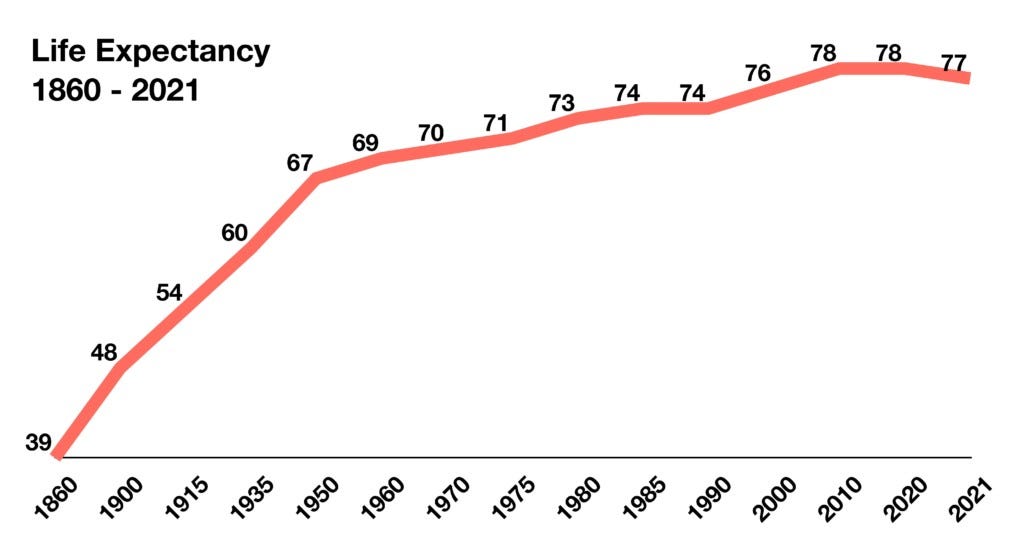
One of the great success stories about America has been the great strides we have made in our health. An average American born just 100 years ago had a life expectancy at birth of only 54. Even in 1950, the average life expectancy was only 69. Today—even after COVID and the opioid epidemic—the life expectancy is 79.2 years, which is a two year improvement over 2021.
What caused this increase? Up until 1950, the biggest factor—and a huge factor at that—was improved hygiene. Americans gained access to clean and safe water, better living conditions, anti-bacterial medicines like penicillin, and improved public health infrastructure. Since 1950, however, the gains have also been the result of universal use of vaccines, an improved understanding of disease leading to effective prevention, and advances in medical therapeutics. This progress was made despite new challenges, such as the increase in obesity and the emergence of HIV/AIDs.
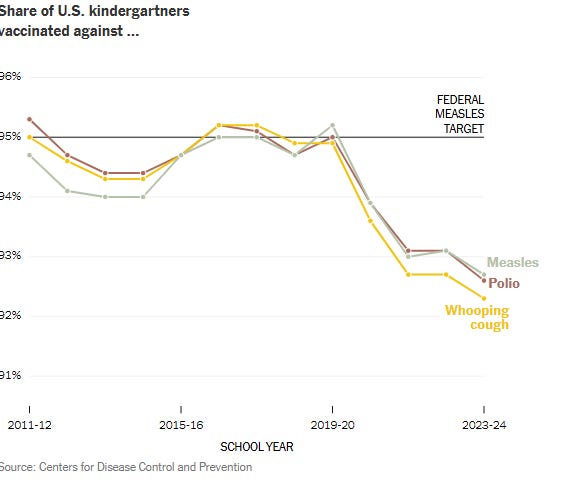
Vaccine development started in earnest in the late 1950s, with vaccines available for smallpox, diphtheria, tetanus, pertussis, and polio. In the 19602, vaccines for measles, mumps and rubella were developed. Vaccines for hepatitis B and the flu became available in the 1980s. Critically, up until 2020, the use of these vaccines was nearly universal and above the 95% level needed to cause herd immunity.
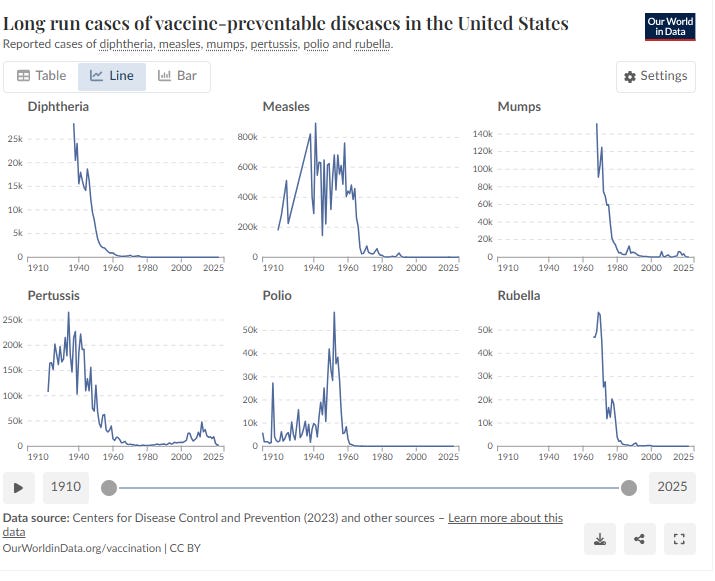
The result was a rapid decrease in the incidence of all of these diseases.
There were also important advances in medical treatments (including prevention) starting in the 1950s. Childhood leukemia was a death sentence in 1960. Today the cure rate is over 90%. Medical advances sharpy reduced the death rates from both heart disease and cancer. As UCLU Medical School explains:
Fifty years ago, the leading cause of death in the United States was heart disease, as it is today, but the death rate was nearly three times higher — 559 deaths per 100,000 Americans in 1965 compared to 192 in 2014. Incidence of cancer was lower in the 1960s, but today the survival rate is nearly 30 percent higher. Life expectancy in the U.S. was 68, meaning most adults didn't live much past retirement age. Today, the availability of more effective treatment has boosted life expectancy to nearly 80.
KFF drilled down on how medical innovation has dramatically important driven treatment of heart disease—the leading cause of death in the U.S.:
In the 1970s, cardiac care units were introduced, lidocaine was used to manage irregular heartbeat, beta-blockers were used to lower blood pressure in the first 3 hours after a heart attack, “clot buster” drugs began to be widely used, and coronary artery bypass surgery became more prevalent. In the 1980s, blood-thinning agents were used after a heart attack to prevent reoccurrences, beta-blocker therapy evolved from short-term therapy immediately after a heart attack to maintenance therapy, and angioplasty (minimally invasive surgery) was used after heart attack patients were stable. In the 1990s, more effective drugs were introduced to inhibit clot formation, angioplasty was used for treatment and revascularization along with stents to keep blood vessels open, cardiac rehabilitation programs were implemented sooner, and implantable cardiac defibrillators were used in certain patients with irregular heartbeats. In the 2000s, better tests became available to diagnose heart attack, drug-eluting stents were used, and new drug strategies were developed (aspirin, ACE inhibitors, beta-blockers, statins) for long-term management of heart attack and potential heart attack patients. From 1980-2000, the overall mortality rate from heart attack fell by almost half, from 345.2 to 186.0 per 100,000 persons.
Sadly, in just six months, the Trump Administration is endangering this progress.
It is hardly an overstatement that HHS under Robert Kennedy, Jr. has radically changed U.S. policy concerning vaccines. Despite the clear success of mRNA vaccines in preventing COVID deaths and hospitalizations, HHs has cancelled all federal support of further research on mRNA vaccines. As the New York Times explains “Unlike traditional vaccines, which can take years to develop and test, mRNA shots can be made within months and quickly altered as the virus changes. The technology won a Nobel Prize in Physiology or Medicine in 2023.”
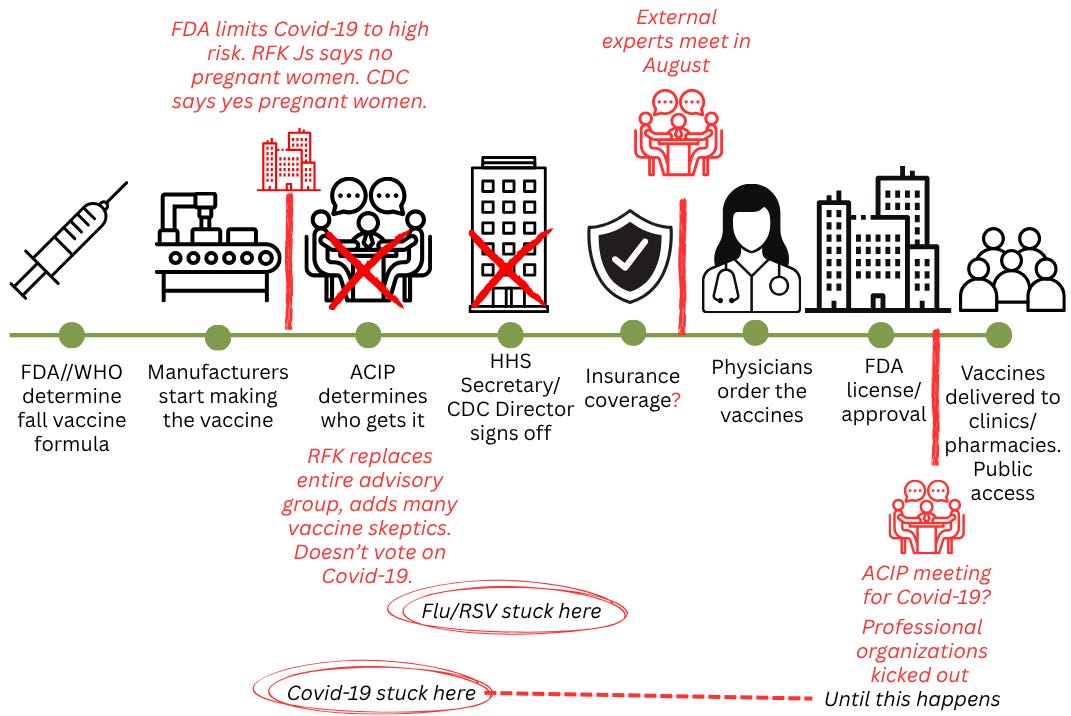
Even worse that this decision has been considered efforts by HHS to limit access to existing vaccines. The delay in approving flu and RSV vaccines for the coming flu season is especially troubling. Usually, an expert FDA advisory group recommends which version of the flu vaccine should be produced based on the current strains, with manufacture of the flu vaccine done over the summer. As Your Local Epidemiologist explains this process is in complete disarray:
Flu and RSV vaccines have been relatively smooth this year, as they were reviewed and recommended by ACIP (CDC’s external advisory committee) in June. But the final sign-off for these typically straightforward vaccines still hasn’t happened. RFK Jr. did revoke authorization for flu shots with thimerosal (based on disproven claims) but has yet to sign off on other flu formulations or the new RSV monoclonal antibody for infants. That delay is highly unusual and potentially troubling, as it could signal plans to restrict access. It could be due to the CDC leadership vacuum (CDC just got a CDC Director last week), but it’s unclear why RFK Jr. would sign off on one thing but not the others.
Even more disturbing has been the large cuts in federal support for medical research. It began with an announcement in February that NIH was cutting $4 billion in funding of medical research through an illegal and unilateral reduction in the indirect cost recovery rate. It was followed by suspension of current research grants to many major research universities, including Harvard.
This was not a fluke. In its official budget to Congress, the Administration proposed a 40% cut in the NIH budget (a reduction of $18 billion).
The improvement in our health over the years was not an accident, but was the result in investments in medical research and a commitment to vaccinations. Under the Trump Administration, we are seeing a large cut in medical research and a hostility to vaccination. This, sadly, will ultimately lead to a reduction in our health.