
Some Thoughts on Yesterday's Election Results

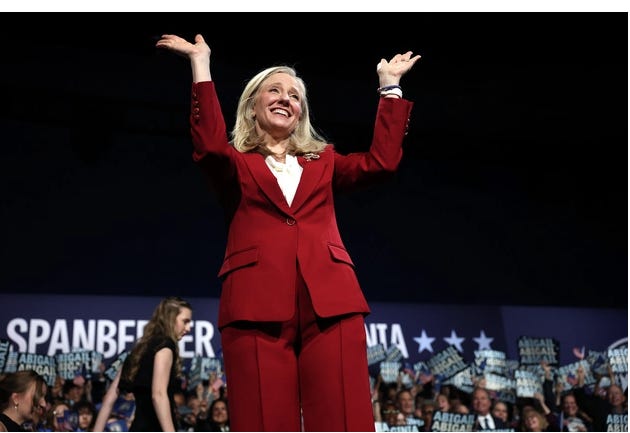
It was a great night for Democrats and suggests that the voters hostility to Trump can lead to historic victories despite the fact that voters really dislike the Democratic party. While the press has focused on the New York Mayor’s race, I think the far more interesting results are in Virginia and New Jersey. As Matthew Ygelesias persuasively argues, it is hardly news that New York City voters elected a progressive. Indeed, it is not even the first time that the City elected a Democratic Socialist—in 1989, they elected David Dinkins, a DSA member.
I think far more interesting is how well Democrats did in both Virginia and New Jersey. The Democratic candidates for Governor won landside elections. The Democratic candidate for Attorney General beat an incumbent despite the fact that he sent toxic and violent texts that received lots of criticism. Even more remarkably, the Democrats picked up at least 13 seats in the House of Delegates to increase their majority from 51 to 64 out of 100 (and one seat remains undecided). The results in New Jersey were the same—the Democrats expanded their majority in the Assembly by at least three, resulting in their having a two-third supermajority.
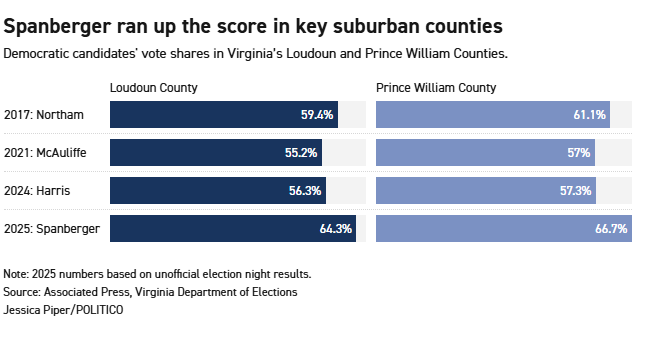
This is all good news for Democrats, but I think the results at the county level are most interesting. In recent elections that Democrats won, they did so by increasing their margins in urban and suburban counties, but even in these successful elections they still lost margins in rural areas. Even in great years for Democrats, Republicans increased their share of the vote in traditionally red counties. Spanberger certainly increased her margins in the key Northern Virginia counties compared to previous elections:
What is most interesting about this election, however, is that Democrats not only increased their performance in urban and suburban counties—they also increased their margins in deeply red rural counties. Spanberger outperformed Kamala Harris in at least 101 of Virginia’s counties and independent cities. In Waynesboro, for example—a city that Trump won by 6 points—Spanberger is leading by 5 points—a big shift in a traditionally republican community.
C. Elliot Morris has done a very interesting analysis that shows this surprising shift in even deeply red communities in all of the states that had elections last night. He looked at how much every county in Virginia, Georgia, New Jersey and Pennsylvania shifted to Democrats from 2024 to 2025. In the chart below, the “horizontal axis shows how Kamala Harris did versus Donald Trump in that county in 2024. The vertical axis shows how the Democratic candidate for governor/court/municipal utility in that county did versus the Republican candidate.” The gray line shows the 2024 results.

As Morris notes, there was “a directional shift toward Democrats in 99.8% of counties that held partisan elections. With few exceptions, voters everywhere moved to the left from 2024 to 2025.”
Morris argues persuasively that the driver for this successful was voter’s concerns about the economy. This was a winning issue for Trump in 2024 and his failure on the economy gave the Democrats the edge even in red counties:
According to the exit polls, voters in Virginia and New Jersey who said the economy was their number one issue voted for Abigail Spanberger/Mikie Sherrill over their Republican competitors by nearly 30 percentage points. In these states, the Democratic candidates for governor are winning 62% of voters who ranked the economy as their number one issue (accounting for 48% of voters in Virginia, and 32% in New Jersey).
So what does this mean for the midterm elections? A great deal can—and will—happen in the coming year and what happens in the next year can certainly affect the election. Still, last night’s election results show that disciplined candidates who focus on issues really important to voters—such as the economy—can be successful across the board.
One note of potentially significant nuance. Many of the Virginia counties which shifted toward democrats have a high population of current or former government workers and contractors. It appears that many were driven by more than a general "concern" about the state of the economy but by specific anger towards Trump for what he has done to the economy. He is being held directly responsible for layoffs, wage freezes, the impact of tariffs, the government shutdown and increased prices. This is consistent with recent polls which show that Trump's personal approval rating is plummeting. It appears that at least in Virginia the GOP is viewed as inexorably the Party of Trump, and the GOP candidates suffered the consequences.