
The Attack on Venezuela

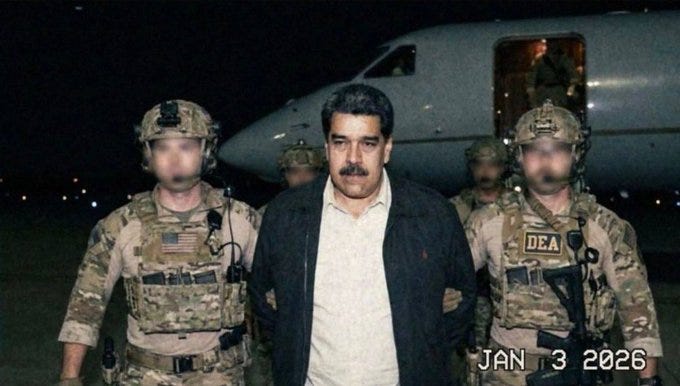
The U.S. military did what it does best this weekend: a carefully planned and executed joint military operation that captured President Nicolás Maduro with apparently very light casualties. The operation showed the strengths of U.S. military power: our cyber assets shut down the power grid in Caracas, our Air Force and Navy assets neutralized the air defense systems using a combination of electronic jamming and kinetic attacks, and our special forces successfully captured Maduro.
We can certainly take pride in the military operation, and there will be few tears about Maduro in Venezuela or elsewhere. He was an illegitimate leader and dictator who has made life miserable for millions. Even so, there are significant problems with this U.S. action. This operation was in clear violation of international law and was done without any input by Congress. It is also not at all clear that the end game here will ultimately advance U.S. interests.
The legal issues are actually the easiest to discuss. This was in clear violation of the U.N. Charter and several other principles of customary international law. I will provide a short summary of these legal issues, but urge you to read the outstanding analysis by Michael Schmitt, Ryan Goodman and Tess Bridgeman in Just Security. These are deeply respected international law experts who spent years advising military and national security leaders on these issues. They generally adopt a realistic view of the law. When they say a military operation is unlawful, it is indeed unlawful.
So what are the legal problems with the attack?
The operation was a clear violation of the U.N. Charter. Article 2(4) of the United Nations Charter that provides that “All Members shall refrain in their international relations from the threat or use of force against the territorial integrity or political independence of any State, or in any other manner inconsistent with the Purposes of the United Nations.” Under the U.N. Charter, the use of force is only permitted if it is either (1) authorized by the U.N. Security Council (such as was done to authorize the Iraq War to liberate Kuwait) or (2) if the action was done in self-defense.
There is no Security Council authorization, so the only possible exception is self-defense. The problem with this justification is that the key requirement for self-defense—that there be an “armed attack”—was not satisfied. Article 51 of the U.N. Charter provides: “Nothing in the present Charter shall impair the inherent right of individual or collective self-defence if an armed attack occurs against a Member of the United Nations.”
There has been no “armed attack” that would justify a self-defense response. The Trump Administration seems to argue that drug trafficking is an armed attack, alleging that we are in a non-international conflict with drug cartels. As I explained in this post (and this post as well), this is inconsistent with longstanding legal principles.
A “Non-International Armed Conflict” or NIAC exists when there is “protracted armed violence between government authorities and organized armed groups or between such groups within a State.” The key agreement that governs this issue, the Additional Protocol II, explains that armed conflict “does not apply to situations of internal disturbance and tension, such as riots, isolated and sporadic acts of violence and other acts of a similar nature, which are not considered armed conflicts.” The international tribunals that have focused on this issue have emphasized that non-international armed conflict requires violence that is continuous and of high intensity, looking at such factors as the number, duration and intensity of individual confrontation; the type of weapons and other military equipment used; the number and calibre of munitions fired; the number of persons and type of forces partaking in the fighting; the number of casualties; the extent of material destruction; and the number of civilians fleeing combat zones.
While cartels are hardly Gandhi-like in their use of violence, any violence directed at the U.S. is too sporadic and isolated to meet the criteria for a NIAC.
Many commentators have cited our invasion of Panama in 1989 as a precedent for this attack. In that operation, there was a military operation to capture to capture General Manuel Noriega in Panama and bring him to the United States to face charges. To be fair, many of us think this operation also violated the U.N. Charter (and the UN General Assembly agreed in a resolution at the time). Nonetheless, the self-defense case for that operation is much stronger than that here. As Schmitt, Goodman and Bridgeman note:
[A]s noted by President George H.W. Bush, the United States acted after the Panamanian National Assembly declared a state of war against the United States, and after forces under Noriega’s command “killed an unarmed American serviceman; wounded another; arrested and brutally beat a third American serviceman; and then brutally interrogated his wife, threatening her with sexual abuse.” Bush added that “General Noriega’s reckless threats and attacks upon Americans in Panama created an imminent danger to the 35,000 American citizens in Panama.” Secretary of State James A. Baker also stated, “We received an intelligence report that General Noriega was considering launching an urban commando attack on American citizens in a residential neighborhood.”
The Trump Administration also suggests that the operation was lawful because it was a law enforcement action to capture two individuals under a Grand Jury indictment. The problem with this argument is that there is no “law enforcement” exception to the U.N. Charter. Indeed, customary international law is to the contrary: consent is required for any law enforcement actions in another country. While U.S. courts have held that criminal defendants cannot use this as a defense to criminal prosecutions, it is still a violation of international law to act in another country without consent.
A related problem is that under customary international law, Maduro enjoyed immunity from foreign enforcement as Head of State. Again, Schmitt, Goodman and Bridgeman offer a good summary of the law:
As noted by the International Court of Justice in its Arrest Warrant judgement, “it is firmly established that … certain holders of high-ranking office in a State, such as the Head of State, Head of Government and Minister for Foreign Affairs, enjoy immunities from jurisdiction in other States, both civil and criminal” (¶ 51; see also Certain Questions of Mutual Assistance, ¶¶ 170-174).
Relatedly, the United States has observed that “in addition to immunity from criminal jurisdiction, heads of state, heads of government, and foreign ministers who enjoy personal immunity also benefit from personal inviolability, a protection that informs their treatment in the criminal context.” Such inviolability includes protection from arrest by other States while in office” ( Comments from the United States on the International Law Commission’s Draft Articles on Criminal Immunity).
While in office, this immunity and inviolability is absolute and bars any form of enforcement jurisdiction by another State.
In discussing all of these legal issues with friends, a common response has been: who cares? This operation was a good thing so why worry about international law? In other words, the ends justify the means. The danger in this argument is that it ignores that these international principles are ones that the U.S. itself was instrumental in establishing. These principles advance U.S. long term interests. They arose out of the bloody half 20th Century, and conflicts in previous centuries as well. Surprisingly, the U.N. Charter was largely successful—while there are certainly exceptions—the number of wars of aggression dropped. We obviously still have wars, but these are most commonly civil wars and not invasions of one country by another. There are obvious exceptions—sadly, many acts of aggression by the major superpowers—but there has in fact been a noticeable improvement. Ignoring the law for short term gain that endangers this success is folly.
We also need to remember that our justifications for this action will be used by our adversaries. It is hard to take a principled stand against Russian aggression against Ukraine (and the Baltic States in the future) if we also engage in aggressive war. Are operations to capture criminal fugitives no longer a violation of international law? Then Iranian and Chinese operatives can now do operations in the U.S. to capture dissidents. And China can bring criminal charges against the President of Taiwan and use that as a justification of an invasion of Taiwan.
In short, our blatant violation of international law has adverse consequences for world stability and U.S. national interests.
It is also not entirely clear that the end game here will be happy for the U.S. or the Venezuelan people.
Maduro is in custody, but his government remains in place. There has been no regime change. Trump suggest that the interim leader—Vice President Delcy Rodríguez—is cooperating, but public statements by Rodríguez don’t support this. More importantly, the hardline leaders of the military and police—who really hold power in Venezuela—have every reason to fight to remain in power. Vladimir Padrino López, Venezuela’s longtime defense minister, and Diosdado Cabello, the interior minister and head of the national police, are hard-liners that are unlikely to let Rodríguez simply hand the country over to the U.S. And the elements of the regime that conducted the election fraud that lead to Maduro’s reelection? Still in place.
It is telling that the Trump Administration dismisses out of hand any notion of supporting opposition leader María Corina Machado or Edmundo González who won more than two thirds of the vote in the 2024 presidential election. Instead, the Trump Administration seemingly plans to keep the current regime in place as long as they will cooperate in allowing U.S. oil companies to reenter Venezuela. There might well be elections (as required by the Venezuela Constitution), but it would be naive to expect the regime not to rig the elections once again. This result may well be great for U.S. oil companies, but it is hard to see how this advances U.S. interests or benefits the Venezuelan people.
Of course, the endgame could be much darker. The hardliners in the regime might well decide to fight. I have little doubt that the U.S. military would prevail, but at a significant loss of life. More troubling is the Iraq scenario, when we achieve a quick U.S. victory only to face violent insurgent actions against U.S. interests. The drug cartels and the hard core members of the regime would certainly have the interests and capabilities to engage in insurgency, as do guerilla groups such as the ELN.
Trump and his supporters are cheering the success of the weekend’s operations, and most Republican elected officials are falling into line. Until the endgame plays out, however, they have no reason to celebrate. And the blatant disregard of the Rule of Law by the U.S. —and the precedent it sets for our adversaries—will undoubtedly have consequences that we will all come to regret.
If this was in fact illegal, what impact does that have on the officers and troops that obeyed an illegal order?
I always enjoy reading Mike Schmitt's work. One can learn a lot of law, especially international law that way.
There is a reason lawyers tell their criminal clients not to say anything to the police unless they are present:
"President Donald Trump quickly took to Truth Social to announce, “The United States of America has successfully carried out a large scale strike against Venezuela and its leader, President Nicolas Maduro, who has been, along with his wife, captured and flown out of the country." (https://www.justsecurity.org/127981/international-law-venezuela-maduro/)
However, I find it ironic that Schmitt argues that Venezuela has or had a legitimate, responsible government that could grant consent for the United States to execute a law enforcement arrest within Venezuela as follows:
"The United States claims, rightfully so, that Maduro’s presidency is not “legitimate.” However, that has no bearing on this situation. Even though the United States does not recognize the Maduro government as legitimate, international law provides that the relevant officials to grant consent are those of the government that exercises “effective control” over the territory, in this case, officials in the Maduro administration (Tinoco Arbitration, pages 381-82). Obviously, no such consent has been granted."
It seems to me that is a real stretch. First, Tinoco was a dispute between Great Britain and a new government in Costa Rica, over a bank deposit for a contract that had been nullified by laws enacted by the Costa Rican government. The decision cited is a decision by an arbitrator resolving a dispute between two parties, not a court of law.
There is another irony as well. Mike states "this operation, striking Venezuela and abducting its president, is clearly a violation of the prohibition on the use of force in Article 2(4) of the UN Charter. That prohibition is the bedrock rule of the international system that separates the rule of law from anarchy, safeguards small States from their more powerful neighbors, and protects civilians from the devastation of war. " That provision prohibits one state from attacking another state because it violates state sovereignty, just as going into another state to conduct law enforcement activities without consent violates sovereignty.
Let's apply this to Ukraine. Vladimir Putin is an indicted war criminal. Let's assume for a moment that the International Court of Criminal Justice decided to prosecute Putin. Since the ICJ does not have a police force, they ask Germany to go to Moscow, arrest Putin, and bring him back to the Hague so he can be tried.
The Russian government, unsurprisingly, doesn't consent. Germany doesn't go, Putin continues to commit war crimes and a couple of million Russians, Ukrainians, Koreans, Chinese, Africans, Europeans, etc. die. How did this UN Charter article protect civilians?
Would it not have been better for some country to take Putin off the stage and let those people continue to live?
It is unfortunate that 40, or so (possibly 150), people were killed in Venezuela. I put the responsibility for that on Maduro. He was offered alternatives and refused to leave peacefully.
I understand why lawyers go to international law as a first resource to find illegality applicable to Trump's actions. I also understand why it is important for us as individuals and nations to adhere to the rule of law. However, when the law doesn't work, we sometimes have to take action to protect ourselves and those who depend on us.