
The "Might Makes Right" Alternative to International Law: A Cautionary Tale from Thucydides

In my last post, I made the case that it was in the national interest of the United States to comply with international law—in particular the limitations on the use of military force in Article 2(4) of the United States Charter. In the wake of the the Venezuelan operation, the Trump Administration has threatened Colombia and Denmark with military force if they don’t cede to US interests, and members of the Trump Administration have begun articulating the “might makes right” alternative to international law.
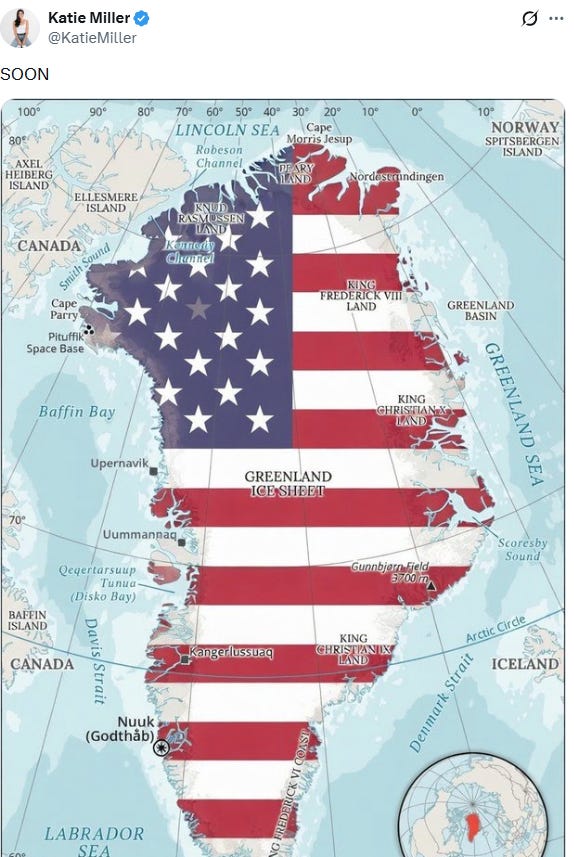
Perhaps the best example is comments that Stephen Miller made to CNN about Trump’s insistence the Denmark give Greenland to the U.S. As the New York Times reported, Miller rejected “international niceties” and asserted a bald might makes right world view:
“We live in a world in which you can talk all you want about international niceties and everything else, but we live in a world, in the real world, Jake, that is governed by strength, that is governed by force, that is governed by power,” Mr. Miller told Jake Tapper of CNN on Monday, during a combative appearance in which he was pressed on Mr. Trump’s long-held desire to control Greenland.
“These are the iron laws of the world since the beginning of time,” he said.
In other words, we are entitled to Greenland because we are stronger than Denmark. Relative power, not “international niceties” should govern. If we want it, Denmark should concede it and let us get our way.
When you are a superpower, the idea that we should always get our way can indeed be attractive. We want something? We get it, no questions asked. What could go wrong?
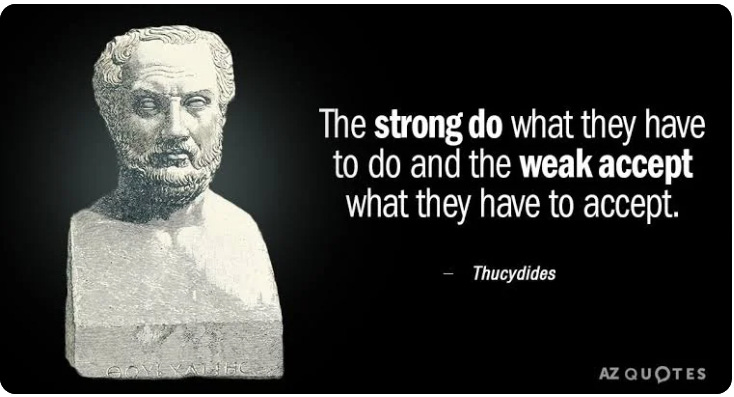
Just ask the Ancient Athenians about what could go wrong. The story is best told by Thucydides in his Peloponnesian War. In a passage of that work known as the “Melian Dialogue”, Thucydides tells the story of the 416 BCE negotiations in which Athens—the Naval superpower at the time— demands the surrender of neutral Melos during the Peloponnesian War with the famous line: "the strong do what they can and the weak suffer what they must." When Melos refuses, it is defeated by Athens, which executes all the men on Melos and enslaved the women and children.
If the story had ended there, it would certainly seem to support a policy of might makes right, but that is not the end of the story. As Thucydides goes on to detail, the Melos victory emboldens Athens to be even more aggressive. It made an ill-advised invasion of Sicily, which resulted in a defeat that lead to rebellions by many of Athens’ allies. By 405 BCE—little more than ten years after the Melos victory—Athens was soundly defeated at a great cost: it loses its democracy and is ruled by tyrants.
History is filled with many other stories in which a “might makes right” philosophy leads to disaster. The Austrian-Hungarian Empire, with the help of Germany, took on a much weaker Serbia. The result was WW I, which led to the dissolution of the Austrian-Hungarian Empire. Nazi Germany in 1940—then in full control of all of Europe—made the unwise decision to invade the USSR, which ultimately led to its defeat. The USSR invaded the much weaker Afghanistan only to suffer a crippling insurgency that greatly weakened the USSR. The nearly 50 years of economic exploitation of Eastern Europe by the USSR ultimately led these nations to reject Russia and move rapidly into NATO and the EU. While the story is still ongoing, the Russian invasion of Ukraine follows this pattern as well. At the very least the invasion lead to the historic decision by Finland and Sweden to join NATO.
Why does this occur? Because even superpowers have their limits and the rest of the world will ultimately respond. Over time, a “might makes right” philosophy to world affairs leads to defeat. Bullies don’t survive forever.
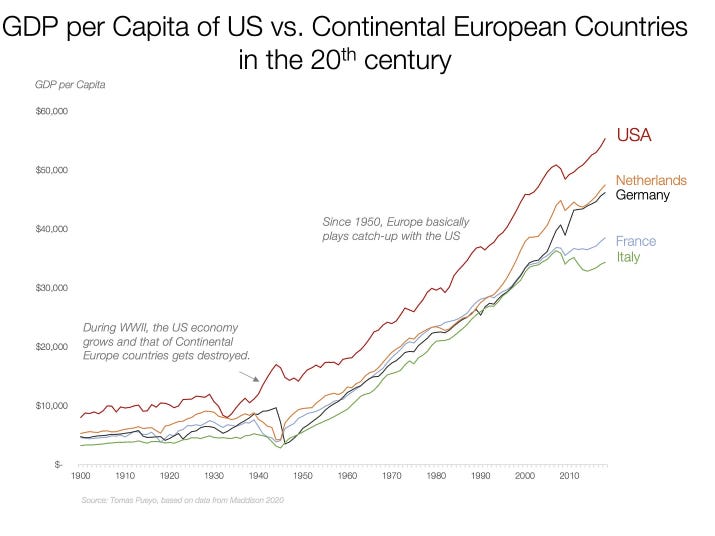
In contrast, the post-WW II U.S. policy of creating and supporting a rules-based international system in which international law is respected (admittedly with some notable exceptions) has served the United States very well for over 80 years. We have alliances that are the envy of our adversaries. Our currency is the world’s default currency giving us huge economic power that enables effective sanctions against our adversaries. We still have the largest economy in the world. As the chart above illustrates, our acceptance of a rules-based international system did not mean the rest of the world took advantage of us. To the contrary, while our European allies certainly did well post-WW II, we did far better.
As Joe Nye taught the world, soft power can often be as important as hard power, and for 80 years, our acceptance and endorsement of international law has been an important part of our soft power.
In short, a world in which we act as if “the strong do what they can and the weak suffer what they must” or a world “governed by strength, that is governed by force, that is governed by power,” may sound great if you have superpower, but history teaches otherwise.
From one lawyer and lover of history to another, thank you.