
Why You Should Read Death Notices

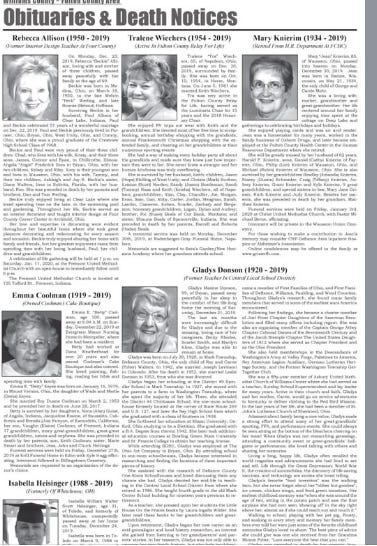
Today I am taking a break from politics and public policy to talk about death notices. Yes, death notices.
In virtually every local newspaper, there is a section devoted to death notices paid for by grieving family members. There are not obituaries—news stories about the life and death of the famous and infamous—but are instead long form classified advertisements that celebrate the lives of ordinary people.
For most of my life, I ignored these notices and did not read them. When my brothers assigned me the task of writing the death notice for my mother, however, I took a look at the notices in the Washington Post to get a sense of what to write. I was enthralled and have been an avid reader ever since. (You can find my mother’s notice here.)
Death notices are paid announcements in newspapers and online platforms providing a short summary of the deceased life as well as funeral service details. They describe the lives of very ordinary people whose first appearance in a newspaper is likely their death notice. That to me is the attraction of the death notices—they are a snap shot of the lives most of us actually live. The stories they tell can be fascinating—stories of surprising career changes, family, and community involvement. Often the stories tell a story of resilience, such as great success after a bad decision or failure. Some of the most intriguing stories tell of remarkably fulfilling lives after retirement.
What is most fascinating to me, however, is what the authors decide to emphasize in the notice. When you pay the newspaper by the word, you need to make tough decisions about what is important. Long death notices in large papers quickly become very expensive so the authors need to make choices about what to write about—and what to leave out. As would be expected in the Washington, DC area, many death notices in the Washington Post spend some time talking about long and successful careers in the military, government service, law firms and think tanks, but that is not what they emphasize. Instead, even in the DC area, the death notices focus on family and community service: the pride the deceased had for their children and grandchildren, the length of a happy marriage, and the years of Little League coaching. And the notices almost always discuss the deceased’s passion for hobbies and activities outside of work.
Perhaps the most remarkable death notice I read was for Carol Sauer, a homeless woman. Her family posted the death notice to celebrate her life, but also to bring awareness to the challenges of mental illness and homelessness:
Living and dying in her own mind Carol Ann Sauer died on New Year's Eve, December 31, 2025. She was 66. It was 11:28 p.m., at Virginia Hospital Center and, according to family, it was the only time she had ever been hospitalized. Neither her age nor her lone hospital stay were overly remarkable, except for the fact that Carol had been homeless in the Arlington area for over two decades.
Had Carol not been hospitalized for pneumonia-turned-sepsis, it's unlikely she would have marked or noticed the new year that was just around the corner. This was not just because she was chronically homeless, but because she existed in a parallel world of paranoia, delusion, and schizophrenia.Of course, it had not always been that way.
. . .
According to the U.S. Department of Housing and Urban Development, chronic homelessness is defined, in part, as being continuously homeless for more than a year. It also involves the presence of a disabling condition, including (but hardly limited to) serious mental illness. Invisible People, a nonprofit newsroom dedicated to the issue of homelessness, notes that, in 2024, more than 750,000 Americans were homeless for at least one night.
For Carol Ann Sauer, it was for more than 20 years.
As you might expect, this death notice went viral.
So what do I get out of reading death notices? I enjoy reading about the very different lives lived by ordinary people. I take solace in how people were able to succeed in life despite adversity. I am inspired by retirees who lived remarkable lives that made a huge contribution to their community even after retirement. The bottom-line, however, is this: these notices often tell compelling stories that are a joy to read.
Love this Chuck. When my Dad passed last year, that writing task was passed to me. When I met with the funeral director he informed me that my Dad had already done it himself. I was a bit surprised to see it written in first person. I tried to change it to a more traditional obituary but the director assured me my father’s instructions were clear. I have received so many positive comments from family and friends … and even a few strangers on the style. Check it out. https://www.legacy.com/us/obituaries/wktv/name/bob-sitterly-obituary?id=58433917