
The Department of Defense Joins the Lawfare Game: Three Observations on the Investigation of Senator Mark Kelly

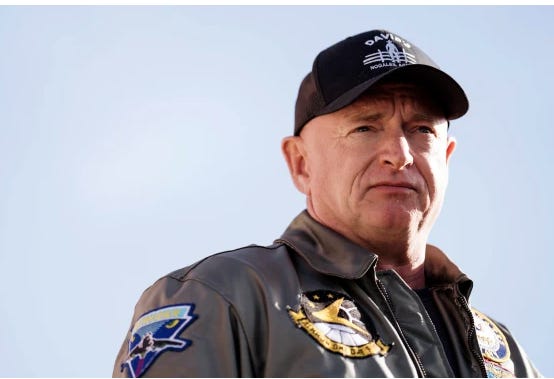
Yesterday, the Department of Defense announced that it was investigating Senator Mark Kelly from the great state of Arizona for “serious allegations of misconduct,” apparently for the fact that he participated in a video with five other Members of Congress that accurately stated that servicemembers should not follow unlawful orders.
If I was still an Adjunct Professor at the ASU Sandra Day O’Connor School of Law, this case would be a great final exam question since it touches on several important topics. Here are some of my observations.
First, it is exceedingly rare for retired members of the military to be investigated, much less charged, under the Uniform Code of Military Justice (UCMJ). The UCMJ does indeed give military jurisdiction over retired members (but not military members who leave the service without retiring), but the exercise of this jurisdiction is very rare. From what I can tell, this has only been done thirty times since the UCMJ became effective in 1951, and all but a few of these cases involved conduct that occurred while the retired member was on active duty. The courts have upheld military jurisdiction of retirees for post-retirement conduct, but the scope of this jurisdiction remains open to debate.
Given that assertions of UCMJ jurisdiction over retirees is so rare, what is going on here? My view is that target of this case is not merely Senator Kelly, but the many military retires that have been outspoken in their opposition to the Trump Administration. The message is: Be careful, we can come after you as well. Fortunately, in my discussions with these military retirees, none will be deterred, and many have instead been emboldened.
Second, it is not at all clear what crime was even remotely committed by the video. Some have pointed to 18 USC 2387, which makes it a crime to, “with intent to interfere with, impair, or influence the loyalty, morale, or discipline of the military or naval forces of the United States . . . advises, counsels, urges, or in any manner causes or attempts to cause insubordination, disloyalty, mutiny, or refusal of duty by any member of the military or naval forces of the United States.”
It is hard to see any case based on this statute surviving a motion to dismiss—all the video did was accurately state a basic premise of military law—unlawful orders should not be obeyed. One can quibble (as I did in this post) over the nuances of the UCMJ that are not stated in the video, but a reminder to military members of this core military principle doesn’t come close to being a criminal act—especially since the video did not call out any particular order that should not be obeyed.
Alternatively, Kelly could be charged with some vague provisions of the UCMJ including provisions prohibiting “contemptuous speech” against the President, conduct that is “unbecoming of an officer...” or conduct that disrupts the “good order and discipline” of the armed forces. Again, it is hard to see how accurately stating the law—while not calling out any particular order—would violate any of these provisions of the UCMJ.
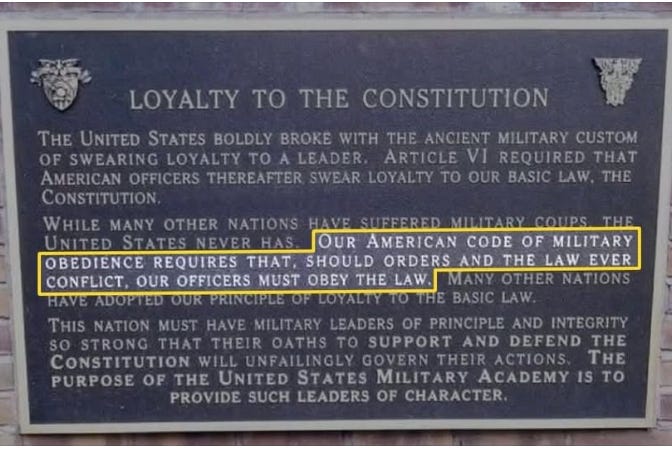
Indeed, the video largely tracked the “Loyalty to the Constitution” plaque at West Point and the lectures commonly given to all Service Academy and ROTC cadets. An argument that the video violated the UCMJ would be silly.
Third, any prosecution based on the video—which is, after all, speech—would violate the First Amendment. It is true, of course, that military members have limits on their speech that ordinary citizens do not face—the prohibition on making contemptuous statements about the President being a prime example—but restrictions that make sense for active duty members of the military do not make sense for retirees. Indeed, even DoD recognizes this reality. It has two directives about political activity by the military—DoD Directive 1344.10 -- Political Activities by Members of the Armed Forces and DoD Directive 1325.06 -- Handling Dissident and Protest Activities Among Members of the Armed Forces—which only apply to active duty members and not to retirees.
In reviewing the free speech rights of military members, the courts have applied a balancing test that looked to the military necessity of of the restrictions on speech. Even for active duty members, the courts have required that the speech restrictions have a “direct and palpable connection” to good order and discipline or the mission. Arguments about good order and discipline or the mission that appear strong when applied to active duty members lose their force when applied to retired members, who no longer command troops or participate in any mission. Simply put, what is a “direct and palpable connection” for speech by an active duty member loses its force for a retiree.
Perhaps the best example of the different standards is the application of UCMJ Article 88, which states “Any commissioned officer who uses contemptuous words against the President, the Vice President, Congress, the Secretary of Defense, the Secretary of a military department, the Secretary of Homeland Security, or the Governor or legislature of any State, Commonwealth, or possession in which he is on duty or present shall be punished as a court-martial may direct.” Given the importance of respect for civilian authorities, this restriction on speech makes sense for active duty offers, but not retired members.
Indeed, the only example I could find of Article 88 (or its predecessor) being applied to a retiree was in 1918 when a retired Army soldier was court marshalled for stating that the President was “subservient to capitalists, and fools to think they can make a soldier out of a man in three months and an officer in six.” Since 1918 there are a myriad of even more contemptuous statements made by retired military members—many about Democratic Presidents—and none have ever prosecuted under Article 88 for good reason.
For this reason, I think even speech that went far beyond the video would be protected Free Speech. For example, what if a retired JAG officer wrote a Substack post that argued that the lethal attacks on drug boats were unlawful—much as I did in this post and this one—and argued that orders to strike the boats should not be obeyed. Would a court really hold that a retired JAG officer—merely because they served in the military—have less First Amendment protection for core political speech than I enjoy? I doubt it.
Again, I think that Kelly is not the only target of this DoD action. Retired members of the military have been very active in the political process—on both sides of the aisle—and have felt constrained by the speech limits applicable to active duty members of the military. It may well be that by going after Kelly for his speech, the Trump Administration hopes to silence its critics in the retired military community. Based on what I am hearing from my friends, this will not work.
Really lucid breakdown of the issue! Thank you! I heard a news story podcast this morning in which the correspondent attempted to explain these same points. I feel like he read your piece!
Great article. This is a terrifying time for those paying attention, and I appreciate your calm, logical presentation. I will be reading more of your work.
I found a minor typo (since/sense) towards the bottom: “Given the importance of respect for civilian authorities, this restriction on speech makes since for active duty offers, but not retired members.”